
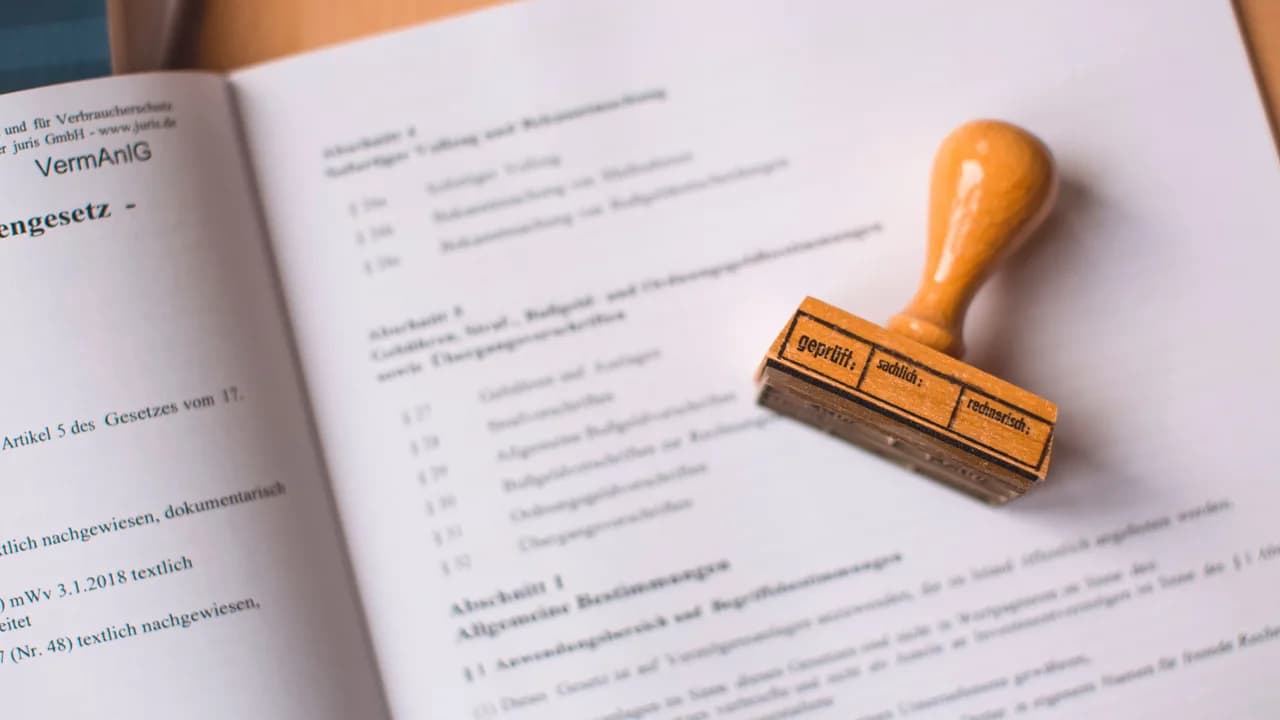
Is a sequential invoice number mandatory?
Yes, and it is a tax-law requirement rather than an accounting convention. The number is one of the mandatory fields an invoice must carry to be valid for input-tax deduction.
- Germany — §14 (4) No. 4 UStG The invoice must show a serial number, issued once only, formed from one or more series of numbers, used to identify the invoice uniquely.
- Austria — §11 (1) Z 5 UStG 1994 The same requirement in the same words: a continuous number with one or more series of figures, used once to identify the invoice.
- The EU floor — Article 226(2) Every member state implements a sequential number based on one or more series which uniquely identifies the invoice. National wording differs; the obligation does not.
The tax office's practical concern is narrow: it must be able to tell that no invoice is missing. Everything below follows from that one purpose.
The German and Austrian rules each sit inside a longer list of what an invoice has to carry — invoice requirements in Germany and invoice requirements in Austria and invoice requirements in Switzerland each have a guide of their own.
What a valid invoice number looks like
The law does not prescribe a format. Numbers, letters, and any separator you like are all permitted, and any of these are valid:
- 2026-0001 — year plus a running count, restarted each January
- RE-2026-0142 — a document prefix, the year, the count
- 2026-DE-0087 — a country segment, for sellers running separate national series
- 10042 — a plain unbroken count that never restarts
Two practical rules the format has to satisfy. Pad the count with leading zeros so the numbers sort correctly in every system that touches them, and pick a width you will not outgrow — a four-digit field runs out at 9,999 and the fix is never convenient. Avoid starting at 1 if you would rather not advertise that this is your first invoice; starting at 1001 is permitted and common.
Running more than one number range
Both the German and the Austrian wording say one or more series, which settles a question people ask constantly: you may run several sequences side by side. Each one has to be continuous within itself.
- By year 2025-0001 … 2025-0431, then 2026-0001. The most common arrangement, and the easiest to reconcile at year end.
- By document type Invoices, credit notes and quotes get their own prefixes. Quotes are not invoices and do not belong in the invoice sequence at all.
- By branch, country or business area Useful when two parts of a business are reconciled separately. The separator is the series, not the numbering rule.
The one arrangement that fails is a single series maintained in two places at once — two people, two spreadsheets, one number range. That is how the same number gets issued twice, and a duplicate is a worse problem than a gap.
What happens when the sequence breaks
A gap is not automatically a problem, and it is not automatically fine either. What matters is whether you can explain it.
- A number issued and then cancelled is explainable — keep the cancelled document rather than deleting it, and the gap has an answer sitting in the file.
- A number that vanished with no record is the case that invites questions, because from the outside it looks identical to a deleted invoice.
- Repeated unexplained gaps can cost you the presumption that your records are complete, which in a tax audit shifts the burden onto you.
- Never close a gap by reissuing the number later. A number used once is used.
The practical version: you are not required to have a perfect run, you are required to be able to account for what is missing. Keeping cancelled documents costs nothing and answers the question before it is asked.
Why the numbers run in order but the dates do not
This is the single most common thing people notice and worry about: invoice 0044 is dated the 3rd and invoice 0045 is dated the 1st. It is not a defect. The number is assigned when the invoice is created; the invoice date is the date of supply or of issue, and those are simply different events that do not always happen in the same order.
Neither German nor Austrian law requires the number order and the date order to agree. Do not renumber invoices to make the dates line up — you would be rewriting numbers that have already gone out, which is the actual violation.

Small businesses, and invoices under the threshold
Two exceptions come up often, and only one of them is real.
- Small-business sellers still number their invoices Being exempt from charging VAT — §19 UStG in Germany, the €55,000 rule in Austria — changes what you show for tax. It does not remove the invoice number. The obligation is unchanged.
- Small-amount invoices genuinely drop the number In Germany, an invoice up to €250 gross under §33 UStDV needs neither the customer's address nor a serial number. Austria's equivalent threshold is €400.
- The exception is narrower than it sounds It applies to the small-amount receipt itself. The moment you issue a normal invoice — because the amount is higher, or because the customer needs a full one — the number is required again.
If your business issues both kinds, number everything anyway. A single consistent sequence is simpler to defend than a rule you have to apply per document.
Thresholds and mandatory fields differ by country — what each country requires on an invoice is set out per jurisdiction.
Sending your first invoice at all? how to invoice as a freelancer covers the rest of the document, not only the number.
Why spreadsheets lose the thread
Nothing here is difficult. What makes invoice numbering go wrong is almost never the rule — it is the filing system, and for a lot of people the filing system is a folder and a good memory.
- Sorting a spreadsheet re-orders the rows but not the numbers already printed on the documents, and the sequence you are looking at is no longer the sequence you issued.
- Duplicating last month's file to start this month's is how the same number gets used twice — the number is in the copy, and the copy does not know it is a copy.
- Two people with the file open at once will both take the next number, and both will be right.
- A folder containing Invoice-final, Invoice-final-2 and Invoice-final-USE-THIS is a numbering system in the same sense that a shoebox is an archive.
Any tool that assigns the number itself removes the whole category of problem, because the number is issued once by something that remembers. That is the actual argument for software here — not that it is faster, but that it cannot lose count.
The same argument, one tool deeper: how to make an invoice in Excel covers why the spreadsheet cannot number reliably in the first place.
If you are still filling one in by hand, our free invoice templates already carry the number field, so the sequence is the only part left to keep.
Common questions
Can I start my invoice numbers at 1001 instead of 1?
Yes. The law requires the sequence to be unique and traceable, not that it starts anywhere in particular. Starting higher is permitted and extremely common.
Do invoice numbers have to restart each year?
No. Restarting annually is a convention, not a requirement. A single sequence that runs for a decade is equally valid — it just gets longer.
What if I accidentally used the same number twice?
Correct it as soon as you find it. Issue a corrected document referencing the original, and keep both. The problem is not the mistake, it is having two different invoices that cannot be told apart in your records.
Can I use only letters in an invoice number?
In practice, no. Both the German and Austrian wording refer to a series of numbers, so a purely alphabetic identifier does not satisfy it. Letters as a prefix alongside digits are fine.
Does a credit note use the invoice sequence?
It needs its own unique number and is normally given its own series with its own prefix. It must also reference the invoice it corrects.
Is an invoice without a number invalid?
For a normal invoice, the missing number means the recipient's input-tax deduction can be refused, which makes it their problem and quickly yours. Small-amount invoices under the §33 UStDV threshold are the exception.
If you would rather not keep count yourself, the free invoice generator fills in the number, the date and the totals, and downloads a PDF. Nothing is uploaded and nothing is kept — so create an account if you want the sequence remembered between invoices.